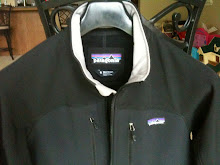
The Men's Capilene 1 Crew
(photo from the Patagonia website)
I came across this article by Sam Anson who is apparently an expert in textiles. He writes about the process and evolution of moisture management fabrics, many of which are used by Patagonia. These fabrics are of course vital for the comfort of those who enjoy outdoor pursuits like hiking, camping, rock climbling, surfing, trail running, and the like.
Moisture Management Fabrics Market Set to Grow to Meet Demand for Performanceby Sam Anson
AKTRIN Textile Information Center
Apparel manufacturers shift their attention to the high-performance end of the Moisture Management Fabrics Market and consumers place increasing importance on the performance of garments, according to the latest issue of Performance Apparel Markets.
Moisture management is one of the key performance criteria in today's apparel industry. It is defined as the ability of a garment to transport moisture away from the skin to the garment's outer surface. This action prevents perspiration from remaining next to the skin. In hot conditions, trapped moisture may heat up and lead to fatigue or diminished performance. In cold conditions, trapped moisture will drop in temperature and cause chilling and hypothermia. Excess moisture may also cause the garment to become heavy, as well as cause damage to the skin from chafing.
Any garment which is worn next to the skin or worn during exercise benefits from moisture management properties. The range of applications for such fabrics continues to expand as new fabric technology is released on to the market. In addition to sportswear and active wear, there is also growing interest in moisture management fabrics from the flame retardant apparel market.
Moisture is transported in textiles through capillary action or wicking. In textiles, the spaces between the fibres effectively form tubes, which act as capillaries, and transport the liquid away from the surface. As a rule, the narrower the spaces between the fibres in a fabric, the more effectively they will draw up moisture. For this reason, fabrics with many narrow capillaries, such as microfibres, are ideal for moisture transport.
Another factor which affects moisture management is absorbency. However, while greater absorbency increases the ability for moisture to be drawn into the fabric, the tendency of absorbent fibres to retain such moisture affects comfort levels, as the garment becomes saturated. It has been shown that fabrics which wick moisture rapidly through the fabric while absorbing little water help to regulate body temperature, improve muscle performance and delay exhaustion.
Generally, the most effective moisture management fabrics are high-tech synthetic fabrics which are made from polyamide or polyester microfibres. These are lightweight, are capable of transporting moisture efficiently, and dry relatively quickly. Moisture management capabilities can also be enhanced by using certain finishing processes, by varying the fabric or fibre construction, or by using a blend of fibre types.
"Push-pull" fabrics -- bicomponent materials composed of a non-absorbent material on the inside and an absorbent material on the outside -- have proved to be an effective construction for moisture management fabrics. This is because the absorbent material on the outside draws the moisture away from the skin while the non-absorbent material keeps the skin dry.
In terms of key producers, one of the world's leading manufacturers of polyester-based moisture management materials is Invista. This company's CoolMax and Thermolite brands are found in a wide range of garments for sports and outdoor activities. However, the pace of development has accelerated over the past ten years, and a growing number of companies are now competing with these brands. Well known names in this field include American Fibers and Yarn, Comfort Technologies, Hind, Honeywell, Intera, Intex, Lenzing, Marmot, Milliken, Mitsui, Nano-Tex, Nike, Patagonia, Pearl Izumi, Polartec, Reebok, Rhovyl, Schoeller, Tomen, USA-Pro, and Wellman. The number of polyester-based moisture management fabrics on the market has also increased dramatically in recent years, and includes Capilene from Patagonia and Polartec's Power Dry.
As manufacturers of sports and active outdoor wear strive to improve the functionality of their collections, the future will see further developments in the field of moisture management fabrics. For example, the area of nano-fibres looks set to revolutionise the moisture management market. In addition, the next generation of "smart" textiles could see the development of fabrics which are able to respond to changes in the environment by adjusting their pore size or thickness to allow moisture through.
Labels: Capilene
 REI is having a major winter clearance sale right now. It started this past Friday and everything ending in .83 is an ADDITIONAL 50% off. It's pretty amazing. I purchased the Patagonia Men's Capilene 3 Zip-Neck (which is still full price, btw; reviewed here) a couple of weeks ago but I also got a kid's one for my oldest daughter. I paid $30 at the time. Yesterday, as part of the sale, I got the one pictured above for my other daughter. See that ".83"? That's right, an ADDITIONAL 50% off that, taking it down to $13 and change. Great deal.